

Pieces on the board
The tokens each faction moves around Arrakis.
Troop
One of the small faction tokens you ship onto Arrakis, stack in territories and send into battle. Each faction starts with a fixed number of them.
The 2019 rulebook calls these tokens forces. Dune Zone says troop, the word its faction editor and catalogue are built on, so one name runs through the whole site.
Say troop instead of
Elite troop
A troop printed with a star that counts for more in battle, such as the Fremen Fedaykin or the Emperor’s Sardaukar.
The rulebook calls these starred forces. Elite troop follows Dune Zone’s choice of troop and names all of them at once.
Say elite troop instead of
Reserves
Your troops that are not on the board yet. You ship them from your reserves onto Arrakis during Shipment and Movement.
The rulebook word. Off-planet and supply describe the same pile less precisely.
Say reserves instead of
Flipped troop
A troop turned over to its back side. Some factions print a different side on the back of their troops, such as the Bene Gesserit, whose advisors share a territory without fighting until they flip back to fighters. A flipped troop follows the rules of its back side.
Dune Zone’s word for a troop on its back side, matching the flip side its faction editor gives a troop. The faction names what each side is called.
Tleilaxu Tanks
Where troops and leaders go when they die. They come back from the Tleilaxu Tanks during the Revival phase.
The rulebook name. Graveyard and dead pile are borrowed from other games.
Say tleilaxu tanks instead of
Token
A flat cardboard component, such as a leader disc or a tech token. Troops are tokens too, but the more specific word is used whenever it applies.
Dune Zone’s word for every cardboard component that is not a card.
Say token instead of
The turn
How one turn of play is divided into phases.
Turn
One full pass through all nine phases. A game lasts a set number of turns.
The rulebook only ever says turn. Round means the same thing, so it is not used.
Say turn instead of
Phase
One of the nine parts of a turn, played in order: Storm, Spice Blow and Nexus, CHOAM Charity, Bidding, Revival, Shipment and Movement, Battle, Spice Collection and Mentat Pause.
The rulebook word for each part of a turn.
Say phase instead of
Bidding
The phase where factions spend spice to buy treachery cards, one card at a time.
The rulebook phase name. Auction describes it well but is a second name for the same phase.
Say bidding instead of
Revival
The phase where factions bring troops and leaders back from the Tleilaxu Tanks. To bring one back is to revive it.
The rulebook phase name, with revive as its verb.
Say revival instead of
Shipment and Movement
The phase where each faction ships troops from its reserves onto the board and then moves one group of troops.
The rulebook phase name, written out in full so it reads the same everywhere.
Say shipment and movement instead of
Spice Collection
The phase where troops standing on spice collect it from the board.
The 2019 rulebook renamed the phase Spice Harvest, but Dune Zone keeps Spice Collection: the phase is about collecting, and Play already calls it that.
Say spice collection instead of
- Storm
- Spice Blow
- CHOAM Charity
- Bidding
- Revival
- Shipment and Movement
- Battle
- Spice Collection
- Mentat Pause
Battle
How factions settle who stays in a contested territory.
Battle
What happens when two factions have troops in the same territory during the Battle phase. Both secretly choose a battle plan, and the loser’s troops go to the Tleilaxu Tanks. Factions battle; they do not do combat.
The rulebook uses battle for the phase, the event and the act, and never uses combat. One word for all three keeps rules text and code readable.
Say battle instead of
Aggressor
The faction whose turn it is in storm order during the Battle phase. It chooses which of its battles to resolve first, and the other faction in each battle is its opponent.
The rulebook word. Attacker suggests the aggressor started the battle by choice, when storm order decides who it is.
Say aggressor instead of
Battle plan
The secret choices each faction makes for one battle: how many troops to dial, which leader to send, and which weapon and defense cards to play.
The rulebook word.
Say battle plan instead of
Dialed
A troop is dialed when its faction sets it on the battle wheel for one battle. Dialed troops add to the battle plan’s strength, and they are lost even when their faction wins. The troops left undialed in the territory survive a win.
The rulebook says forces are dialed on the battle wheel. Spent and committed name the cost; dialed names the act. Paying spice for a dialed troop is a separate choice, called supported.
Say dialed instead of
Supported
A dialed troop is supported when its faction pays spice for it in a battle, so it counts at its full strength. A troop dialed without support counts for less.
The advanced rules say troops are supported by spice. Dune Zone uses the same word for the strength and the cost: supported strength and support cost.
Say supported instead of
Battle wheel
The dial each faction turns in secret to choose how many of its troops in the territory fight the battle.
The rulebook calls the component the battle wheel; dial is what you do with it.
Say battle wheel instead of



The board
The places on the map of Arrakis.
Territory
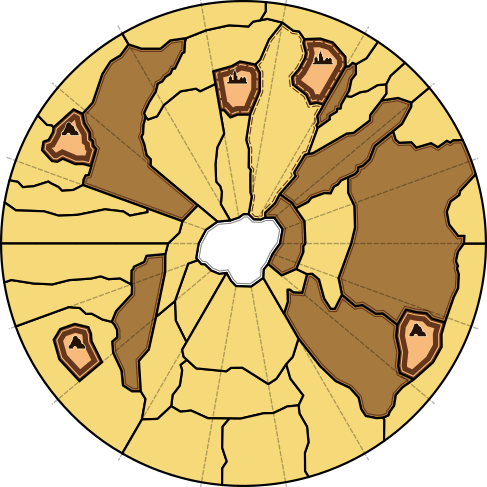
A named place on the map, such as Arrakeen or the Shield Wall. Troops move between territories, and battles happen inside one.
The rulebook word. Region already means something else in Dune Zone’s rulebook editor, and area and zone are vaguer.
Say territory instead of
Sector
One of the eighteen wedges the board is divided into. The storm moves sector by sector, and one territory can span several.
The rulebook word.
Say sector instead of
Stronghold
One of the five protected territories: Arrakeen, Carthag, Sietch Tabr, Habbanya Sietch and Tuek’s Sietch. Holding enough of them wins the game.
The rulebook word, used for cities and sietches alike.
Say stronghold instead of
Storm
The great sandstorm that sweeps around the board each turn, destroying troops and spice out on the sand in the sectors it passes.
The rulebook word.
Say storm instead of
Spice
The one currency of the game.
Spice
The currency of the game. Factions collect it from the board and spend it on cards, shipping and battles.
The rulebook word. Melange is the same substance in the novels, and credits or solari are a different currency.
Say spice instead of
Spice Bank
The shared pile of spice that belongs to nobody. Spice you pay goes to the Spice Bank, and spice you collect comes from it.
The rulebook word. Spice supply and spice pool describe the same pile.
Say spice bank instead of
Spice reserve
A faction’s personal spice reserve: the spice it owns, kept behind its shield. Short for faction’s personal spice reserve. Spice you collect goes into it, and spice you pay comes out of it.
Dune Zone’s name, so a faction’s own spice never gets mixed up with the shared Spice Bank. Play used to call it a bank.
Say spice reserve instead of

Cards
The decks every game uses.
Treachery card
A card bought during Bidding: weapons, defenses and special effects you play in battle or at other moments.
The rulebook word.
Say treachery card instead of
Traitor card
A secret card naming a leader. If that leader is sent into battle against you, you can reveal the card to win that battle.
The rulebook word.
Spice card
A card from the spice deck, turned over during Spice Blow to show where new spice appears or when a sandworm strikes.
The rulebook word. Territory card names the card after what is printed on it rather than the deck it belongs to.
Say spice card instead of
Karama
A treachery card that lets you break the rules once, usually by cancelling another faction’s advantage.
The rulebook spelling.
Say karama instead of



Factions and people
Who plays, and what they play as.
Faction
The side you play as, such as the Atreides or the Fremen. Each faction has its own troops, leaders and advantages.
The rulebook word. House is part of some faction names, like House Atreides, but is not a word for factions in general, because the Fremen and the Spacing Guild are not houses.
Say faction instead of
Advantage
A rule that only applies to one faction and breaks the normal rules in its favour. Faction sheets list each faction’s advantages.
The faction sheets call these advantages. Ability and power describe the same rules with a second and third name.
Say advantage instead of
Leader
A named character disc a faction can send into battle to add strength. On Dune Zone, every faction has one faction leader, shown on its shield, and a roster of supporting leaders.
The rulebook word.
Say leader instead of
Faction leader
The one leader that represents a faction, shown on its faction shield. Its other leaders are supporting leaders.
Keeps the shield leader apart from the supporting leaders. Hero is kept only for the treachery card Cheap Hero, which stands in for a leader.
Say faction leader instead of
Kwisatz Haderach
The Atreides’ special token. Once the Atreides have lost enough troops, it can join a leader in battle, adding strength and stopping that leader from turning traitor.
Written out in full so new players can look it up.
Say kwisatz haderach instead of
Alliance
An agreement formed during a Nexus that lets factions share a victory and some advantages. Each member is the other’s ally.
The rulebook word, with ally for each member.
Say alliance instead of
Deals
What factions promise each other at the table.
Deal
A spoken agreement between factions that are not allies, about spice, secret information or what they will do later. A deal cannot hand over treachery cards, leaders, troops or faction advantages, and cannot break the rules.
The rulebook word. Pact names the same thing.
Say deal instead of
Binding deal
A deal its factions must keep. The rulebook makes every deal binding once it is stated aloud, so no faction can back out of it. Talk that was never stated as a deal, such as a hint about what you might do, binds no one.
The rulebook says deals must be honored but has no name for that. Dune Zone says binding deal when it matters that the deal is kept, and plain deal otherwise.
Bribe
A deal in which one faction pays another spice for something in return, such as staying out of a territory. Like any deal it must be stated aloud and kept. The spice waits in front of the receiving faction’s shield and joins its Spice reserve during the Mentat Pause.
The rulebook word. Every bribe is a deal; a deal without spice paid for it is not a bribe.